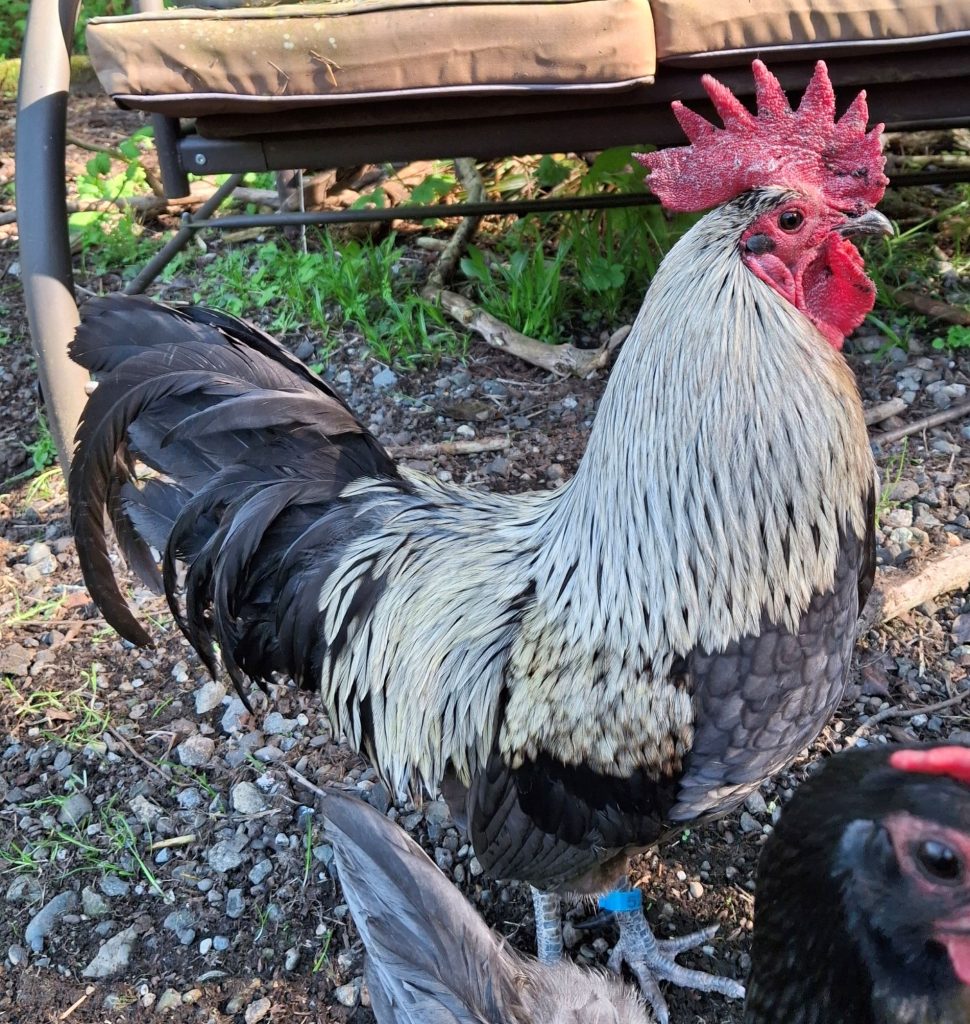
Silverudd’s Blues
This breed was developed in the 1970s by Sweden’s famous chicken breeding pastor, Father Martin Silverudd, who called them “the special blue bird that lays green eggs”. He sought to create a small yet prolific layer of large blue-green tinted eggs, capable of achieving commercial levels of production. Martin worked on the breed until he passed in 1986. The breed was almost lost, until the Swedish Cultural Hen Association pieced it back together, but not without some inadvertent crossbreeding. The breed was imported to the United States only twice, in 2011 and 2013, under the name Isbars. In 2016, the name officially changed to Silverudd’s Blue, and we’re all still catching up on that. Although the US lines still suffer from genetic contamination, several backyard breeders are diligently working to restore the original qualities that marked Martin’s stated legacy – a production-level green egg layer.
Green Eggs?? Really?
Yes! Green Eggs! Highly sought after in backyard flocks who are looking to set themselves apart from the crowd, green eggs are eye-catching and unique.
They can range anywhere from pale minty green, to seafoam, pistachio, even darker khaki and moss green. I personally haven’t seen anything in the darker olive shades from my lines, but I hear that they’re out there too.
Not only are they green, but they can also have spots, splotches, and speckles, which range from white, cream-colored, brown, darker greens, and yes, even purple!
My favorite egg shades are minty green with purple spots. They really are little dinosaur eggs!
Understanding egg color (the process in detail)
Just like an oil painting has several layers that determine what we finally experience as color, so do chicken eggs. Egg color is generally determined by 3 things – the color of the shell’s calcium, the exterior “paint” itself, and finally the glossy protective bloom.
For all chickens, an egg takes about 26 hours to form. At about 5-6 hours in, the calcium of the egg shell starts forming. Some chickens have a genetic trait that causes them to leak Oocyanin (notice cyan in that name?) into their white calcium, turning the calcium cyan-blue. More on what caused this fascinating genetic trait later…
Then, during the final 3-4 hours of forming, SOME chickens spray a a tinted brown pigment, called protoporphyrin, over the top of the eggshell. Go check your brown eggs. They’re white on the inside! Some chicken breeds don’t produce protoporphyrin, and some do.
Why? Well, human breeding… But also – because some dinosaurs buried their eggs (white), and some laid them atop the ground (brown)! Birds didn’t bury, they open nested, so their eggs became light brown, in order to hide better. When we bred for commercial production, we accidentally devolved our brown egg-laying cluckers back a step, and made white eggs.
That’s right – white eggs are the anomaly, and not the standard for chickens. White eggs are an egg-burying lizard trait, and (most) chickens don’t bury their eggs!
And I say spray because, like a sprayer, sometimes things get gunked-up and the pigment doesn’t come out uniform. It can splotch, resulting in the highly prized speckles and spots people love. Pigment isn’t consistent. Some breeds, like Marans, produce LOTS of it, making very dark eggs. Others, like Rhode Island Reds, produce very little, making very light brown eggs. There’s also more of it at the beginning of the season, when a hen hasn’t been laying for a while, than there is later on in the season.
Finally, in the last hour or two, the hen adds a wet protein substance, a cuticle, that we call the bloom. This is a glossy, protective layer that fills in microscopic pores and protects the embryo inside from bacteria and disease, and makes the eggs shelf-stable. This gets washed away in commercial facilities, requiring store-bought eggs to be refrigerated.
Acting like a frosted glass, refracting how light plays on the surface, the bloom causes all sorts of changes in the egg’s tonal colors, it can add a hint of dusty pastel, or a milky whitish or even grey appearance. Sometimes the bloom also carries just a touch of that same protoporphyrin pigment, resulting in anything from pale hints of pinks all the way to opaque plums.
But how does an egg become green?
When we take a blue-egg laying chicken and cross it with a brown egg laying chicken, the offspring will end up laying green eggs. At least for one generation, and maybe even a few in the second generation, depending on the genes involved. The result quickly dissipates if you keep breeding.
We’ve been making hybrid green egg layers for decades. In fact, we’re pretty good at it. We call them Easter Eggers, or Olive Eggers, or even Moss Eggers. But, we have to wait a year to see what the resulting children’s eggs look like, and you might end up with a non-green layer. Also, subsequent generations fail out – you have to continue breeding in more blue or more brown layers, and that takes a lot of work, maintaining multiple lines and roosters.
How did viruses play a role in egg colors?
Believe it or not, it took a virus to bring us all this amazing color goodness. The story starts with the infamous Araucana chicken breed and the Endogenous Avian Retrovirus (EAV-HP). Or, actually, the Araucana’s ancestor breed, the Mapuche chicken. Or, actually, being fair, there’s an Asian version of this exact same story, affecting 2 other breeds. The EAV-HP attacked twice in separate continents, but let’s stick with the Araucana’s history.
The EAV-HP retrovirus started infecting chickens in South America several hundred years ago. The virus lost the war, but not before it rewrote some of the chicken’s genetic code regarding …liver proteins. And now, those chickens make liver proteins outside of their liver… even in their oviduct and shell manufacturing glands… where the calcium acts like a big sponge and sucks them up… which turns the calcium…. blue!
This protein was called oocyanin – literally egg-cyan-pigment. It’s also called biliverdin, or literally, bile-green-pigment. You and I are probably more familiar with bilirubin, bile-ruby-pigment. All the same stuff.
It’s theorized that the Mapuche people selectively kept infected chickens over non-infected chickens, because they thought blue eggs were cool! But that wasn’t the only genetic anomaly re-written by retroviruses. Chickens down there also lost their tail feathers, doomed to walk around with this weird rumpless shape, and grew these wacky tufted beards from their cheeks. When those qualities were bred together, the Araucana chicken breed was born.
The Araucana was later brought to the US and Europe, but Americans couldn’t handle the bird’s looks. Without tail feathers, it looked too much like the shape you’d expect at the dinner table. They immediately bred the tail feathers back in, also fixing the pathetically low hatch rates that plagued the breed, losing some of the vivid sky-blue eggshell in the process, and creating what is now known as the Americauna breed.
What’s so special about Silverudd’s Blues being a breed ?
That means that you don’t have to maintain two separated lines of chickens, with breeding pens, multiple roosters, etc, in order to hatch more green egg layers. You can now do it with ONE pen, ONE rooster, and ONE flock.
They are the very first official breed capable of laying green eggs that has ever been created. That means they lay green eggs without needing to be crossed with any other breed to do it, consistently, generation after generation. They are a true-breeding chicken line, meaning that their children will always remain true to what their parents were.
Before this, such as with Easter Eggers, in order to hatch more, you had to keep one line of a blue-egg-laying chicken, and another line of a brown egg laying chicken, and then cross them. Depending on the quality of your other two lines, sometimes you had to wait to see what color eggs the offspring would lay, and any other attributes were just a shot in the dark.
What about their plumage and feather patterns?
They also offer several plumage colors, coming in Black, Blue, and Splash varieties, allowing backyard breeders to dabble in the genetics of feather patterns and creating some variety in the backyard ornamentation. So, they’ve got a lot to offer above just their green eggs.
How is it possible to have multiple feather colors in one breed?
Martin was well known for ensuring his flocks made for good backyard ornaments, as well as everything else. He’s responsible for giving us other chicken breeds such as the 55 Flowery, Smaaland, and Queen Silvias, all of which are heavily defined by their plumage, so playing around with feather genetics wasn’t new to him.
The Silverudds Blues, though, definitely went a different way. There’s a gene called the Blue Dilution gene, and this is the only breed that Martin worked it into. It does some really cool things, modifying a bird’s existing base feather coloring, but it doesn’t “breed true”… meaning that it is … consistently … inconsistent …. (What’s not to love!)
Blue Dilution sets up 3 different feather patterns of Blue, Black, or Splash, also called the BBS pattern.
How does the Blue Dilution gene affect feather pigment?
It’s a classic game of Mendelian genetics. Remember him? Gregor Mendel? He was another monk, like Silverudd. (It’s always the monks!!) He discovered the mathematical ratios in genetic traits. Then, Reginald Punnett (technically not a monk!) drew it out for us visually into that thing called the “punnet square” so we could all make sense of it. Here’s what that looks like with the blue dilution gene:
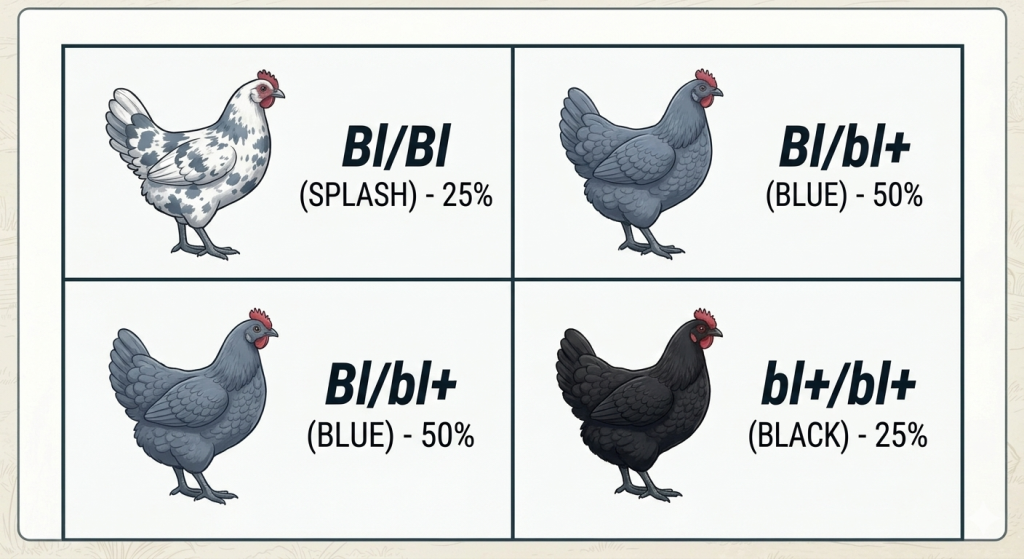
I know. They make genes hard to read.
So, if you get no copies, you just have black feathers. With only 1 copy, your black feathers turn blue, and with two copies, you turn into a dalmation!
That’s it, Thats Blue/Black/Splash genetics, or BBS. Blue dilution gene is what.
….. Think of (Bl) as ON and (bl+) as OFF. Plus signs mean base, so unmodified.
The underlying bird IS black. So, when there is no dilution modifier, you see a black bird.
When just one of the dilution genes gets turned on, it dilutes the amount of pigment, so that the feathers show up a cool slate blue-grey.
When two dilution genes get involved, they inconsistently turn off ALL the pigment, resulting in mostly white feathers, with a few that maintain some of their pigment, creating blue/black splashes on an otherwise white bird.
How does Blue Dilution gene show up across different parent crosses?
Because the blue dilution gene doesn’t “breed true”, the Blue/Black/Splash pattern allows for different combinations of parents to create different combinations of offspring. If it “bred true”, then all the chicks from all the combinations would all be the same.
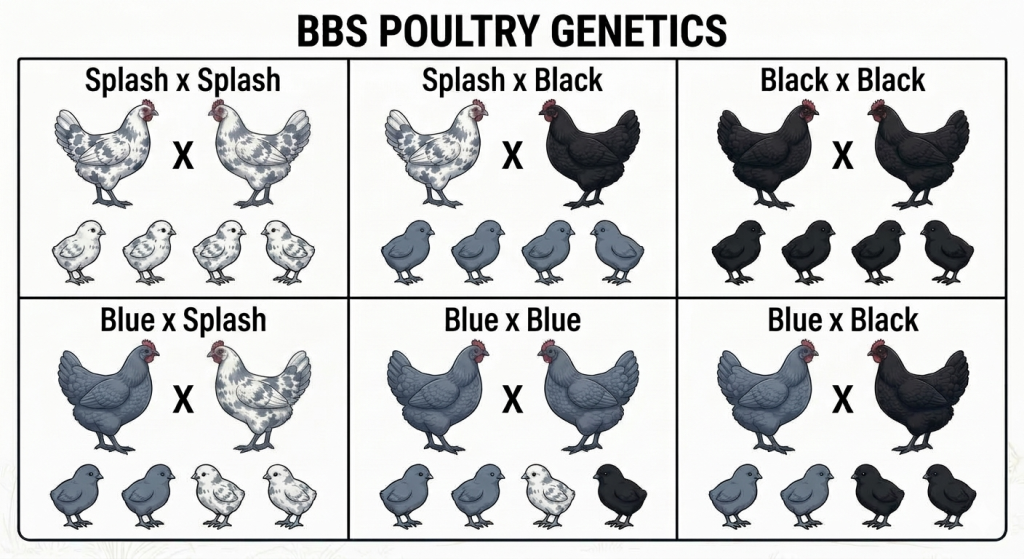
But, since they’re NOT, you can take two blue parents, and hatch a clutch of blue, black and splash babies! Or, you can take black and splash parents, and hatch something that completely doesn’t resemble them!
You can breed Splash to Splash, and breed true. You can breed black to black and breed true. But with one single blue, in a quick 2 generations, you can swap to an entirely different color line.
Do they really lay lots of eggs?
The breed was made to be a powerhouse egg producer, laying copious amounts of Grade A Large eggs. They were intended to compete with commercial breeds, so they were created to have smaller bodies, meaning higher feed-to-egg conversion ratios. People agree the number is somewhere between 250-300 eggs annually, but I think they’re capable of exceeding 300.
What other attributes make them stand out?
They also stand out for numerous other qualities, the least of which are their stunning single-combs, lack of beards, and presence of tails (gasp!). All of these are often times lacking in the normal green hybrids. And how could I not also mention their amazing, inquisitive personalities, with even the roosters making great cuddly pets.
…Although, I admit to liking the bearded chickens. Their weird fluffy cheeks ended up winning me over.
Silverudd’s Blues are extremely docile, bred to be less spastic than other chickens, so that they have more energy dedicated to egg production.
They are excellent foragers, as foraging keeps feed costs down.
Although low energy, they remain highly food motivated, easily coaxed into socializing for a treat.
They make excellent pets, good at bonding with their caretakers.
They do well in confinement, and don’t get fidgety inside a confined space.
They excel at free ranging, unafraid of exploring, and capable of keeping themselves safe.
Are they Isbars or Silverudd’s Blues?
Great question! They were imported to the US under the incorrect name of Isbar Blå, but that name points to two very different breeds (and was later changed). It’s very easy to tell the two apart, and the answer is directly in the names – Blue and Bar.
Isbars have a barred feather gene. This gene makes black and white lines across each feather.
Silverudd’s Blues have a blue dilution gene. This gene uniformly dilutes the base feather color, not in stripes or lines, but solidly.
So…. There’s never been a Blue Isbar. It’s not a thing.
An Isbar is actually a Silver Barred Rhode Island Red (SBRIR). Instead of saying SBRIR, Isbar combines the ISland and the BARred names together. In other words, the Isbar was Martin’s version of a Rhode Island Red with a permanent autosexing capability. (see 1)
Can you explain all the naming confusion?
The Silverudds Blues project went through decades of naming confusion before its history was properly pieced back together. The problem is, Martin passed in 1986, without filing his “official” breed standards (supposedly). In 1990, someone who was piecing everything back together made an honest mistake, and inadvertently associated the notes on the two breeds (which were all in the same paragraph (see: 2), and dubbed them Isbar and Isbar Blue. That mistake stood for over 25 years.
Martin had actually called his new line “Svensk Grönäggsvärpare” (Swedish Green Egg Layer). Martin’s working name was a little generic, so in 2016 the Swedish Cultural Association officially renamed the breed to Silverudd’s Blues, fixing the mistake, identifying the blue dilution gene, and honoring Martin’s final work.
Where do Silverudd’s Blues genetics come from?
Martin was a brilliant geneticist, and the Silverudd’s Blue (his Swedish Green Egg Layer) was the last breed he ever created. It was a distinctly different turn, separate from ANY of his other work, which had been previously focused on auto-sexing, barring, and wild-type plumage patterns.
Not including any of these characteristics was an intentional change. Instead, he became deeply focused on utility and egg production, versus the aesthetics side.
Martin’s notes say he began with a base of 75% Alexander Rhode Island Reds (for their high egg production) and 25% New Hampshires (for their hardiness and bodies). To that, he needed to add the blue-egg gene, and the Blue Dilution feather gene to get where we’re at today.
Where does the blue-egg gene come from?
For the blue egg gene, he did NOT add raw Cream Legbars, as many believe, because they didn’t survive the cold Swedish winters very well. Instead, he integrated one of his own breeding projects that he had been working since the 1950s, the Silverudd Safir. The Safir line incorporated English Cream Legbars (adding the blue egg gene), Old Heritage Swedish Leghorns, and New Hampshires. Unfortunately, this line was lost to time. No photos of it survived, but they were said to be light brownish-yellow with a contrasting brown and black pattern who laid blue, brown, and green eggs (EG: they were a non-complete breed). 3
Where did the blue-dilution gene come from?
The rest of the final recipe is anyone’s guess, as Martin’s notes were “incomplete”. We know there’s more, because nothing so far includes the blue dilution gene that the breed is named for! Some suggest Blue Andalusians, but that seems to go against the desired temperament he fought so hard for. The Blue Plymouth Rock has been mentioned, and although they have a high egg production, their yellow legs and yellow beaks don’t seem to fit.
We do know that Martin had Blue and Black Australorps on his property. Australorps would have carried the Blue dilution gene, are exceptionally prolific layers, match the temperament profile, match the leg and beak colors, AND bring the body and hardiness to the table that Martin started fixating on while he built this breed. (check, check, and check…?)
So what wasn’t completed before he died?
As his ONLY blue dilution gene project, Silverudd’s Blues stand completely isolated from his other work. Some speculate that he wanted to add the auto-sexing into the breed before finalizing it, but I’m not sure that was his intent.
His journals talk about body structure and climate hardiness. They talk about selecting exceptionally calm, low-energy temperaments, which all lead to better egg production. They talk about …. utility.
With the Australorps found on his property at his death, perhaps he intended to deepen the solid black base, darken the legs, and continue fortifying the breed, in weight, temperament, and metabolic feed conversion.
Perhaps he was just stuck in an amelioration loop. perfecting those production-level qualities. That all align with his documented goals… which I believe he nailed. But maybe he still saw more room for improvement. Perhaps he wouldn’t feel they were complete until they laid at least 350 eggs a year.
I’m OK not knowing. We all can speculate, and try our own hand at adding what else we think we might want.
But all in all, I’m hard pressed to find a better set of genetics, a better platform, to begin from. Whether we want to darken the egg color, add weight to the body, increase the eggs, or just ensure the line is clean, he left us a great base to work from,